Lake Nakuru Safari: Rhinos First, Flamingos as a Bonus
Lake Nakuru is one of Kenya’s best places to see rhino — both black and white — plus the rare Rothschild’s giraffe, lions and leopards, all in a compact, easy-to-explore park about three hours from Nairobi. It was the country’s first rhino sanctuary, and it’s fenced, which is why you’ll see rhino and giraffe here that are hard to find elsewhere (and why it’s the one park with no elephants). You’ve probably seen the old photos of a shoreline solid with a million pink flamingos — and here’s the honest part most guides skip: that spectacle has become unpredictable, because rising water levels changed the lake. Flamingos still turn up, sometimes in the thousands, but you should come for the rhinos and let the flamingos be the bonus they now are.
What and where Nakuru is
Lake Nakuru National Park sits in the Great Rift Valley, wrapped around a shallow soda lake on the edge of Nakuru town — close enough to Nairobi (roughly three hours) to fold neatly into a wider Kenya route. It’s a compact park, and that’s part of its charm: you’re not covering huge distances between sightings, so a day here is unusually productive. Acacia woodland, open grassland, yellow-barked “fever trees,” rocky escarpments with sweeping viewpoints, and the pale lake at the center.
One thing that makes Nakuru different: it’s fenced. The fence is what makes it a rhino stronghold — and it’s also why there are no elephants here, since the park is too small to hold them. So set your expectations accordingly: this is rhino-and-cat country, not elephant country.
The reliable stars (this is why you come)
Forget the flamingos for a moment, because the animals that make Nakuru worth a stop are here every single day.
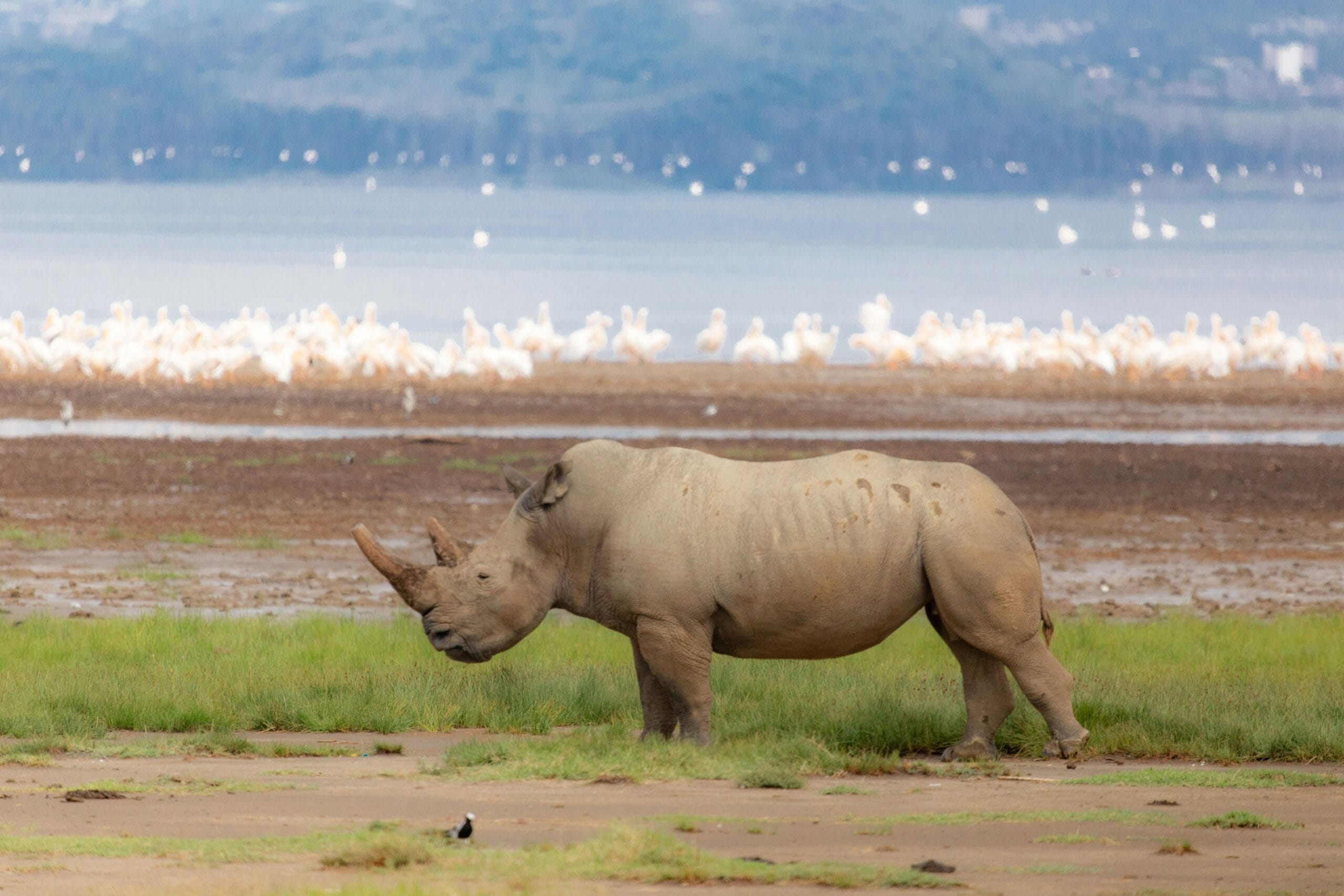
Rhino. Nakuru was designated Kenya’s first rhino sanctuary back in the 1980s, and it now protects both black and white rhino — one of the surest places in the country to see them, often grazing right down by the lakeshore. For many first-timers, this is the trip’s rhino guarantee.
Rothschild’s giraffe. This endangered subspecies — you’ll know them by the clean white “socks,” as if they forgot to finish their leg markings — was brought here for protection and thrives. Nakuru is one of the best places anywhere to see them.
Cats and the rest. Lions, leopards draped in the acacias, buffalo, waterbuck, zebra, hippo in the shallows, olive baboons and colobus monkeys in the trees. The compact park keeps it all close.
The flamingos — the honest truth
Here’s the thing to know before you go, because it’s the single biggest source of disappointment at Nakuru.
For decades, Nakuru was the flamingos — a shoreline so pink you couldn’t see the water, over a million birds feeding on the lake’s algae. Then, from around 2010 onward, the lake began to rise. It nearly doubled in size, the water diluted, and the algae the flamingos feed on collapsed. The birds did what birds do: they left, mostly for nearby Lake Bogoria, chasing the food.
Today, flamingos still gather at Nakuru — sometimes in the tens of thousands, in shifting, nomadic clusters — but the wall-to-wall pink spectacle is no longer something anyone can promise you on a given day. It comes and goes with the water and the algae.
So the honest planning advice, which every serious guide now gives, is simple: come to Nakuru for the rhinos and the giraffe, and treat any flamingos you see as a lovely bonus. If a big pink flock is genuinely the thing you’re chasing, that’s a conversation to have with us before you book — it may mean timing, or adding a different lake — and we’ll tell you plainly what’s realistic.
What else you’ll see
Nakuru rewards you beyond the headline animals. Climb to Baboon Cliff or Lion Hill for a sweeping view over the whole lake and valley — the classic Nakuru photograph. There’s a pretty waterfall in the south of the park. And even on a quiet flamingo day the birdlife is generous: pelicans, cormorants, storks, kingfishers, fish eagles, and dozens more. It’s a busy, colorful park, not a one-trick lake.
Honest notes (so nothing surprises you)
- Flamingos are never guaranteed. We’d rather you arrive hoping than expecting. The rhinos carry the day on their own.
- No elephants here. The fence that protects the rhinos means the park can’t hold elephants — those come elsewhere on your route (Amboseli, the Mara).
- It’s a short, high-yield stop. Compact distances mean a lot of wildlife in a little time — which is exactly why it slots so well into a multi-park Kenya trip rather than as a destination on its own.
- Best light is early. Dry-season mornings (June–October, January–March) give the clearest air, the best light off the lake, and the most active animals.
How Nakuru fits your trip
Lake Nakuru is the Rift Valley heart of all three of our Kenya routes — it anchors the lakes leg between the wilder north or the Amboseli plains and the grand finale in the Maasai Mara. On the Nine-Day Explorer and Nine-Day Signature it’s a reliable, rhino-rich change of pace mid-trip; on the shorter Six-Day Classic it pairs with the Mara for a tight, high-yield first safari. Either way you’re in your own private 4×4 with a guide who gets you to the rhino and the viewpoints at the right hour — planned honestly, flamingos and all, by someone who’s stood on that shoreline herself.
My Lake Nakuru (first person — Milli)
(Milli to tune to her actual June 2022 memory.)
I’ll be honest about what I expected at Nakuru: the pink. The photos everyone’s seen. What I remember instead is a white rhino grazing so close to the road that we just sat and watched, and the Rothschild’s giraffe with their tidy white socks moving through the fever trees. There were flamingos — scattered, not the endless carpet from the old postcards — and you know what, it didn’t matter. The park gave us more than enough.
That’s the Nakuru I send people to now: come for the rhino you’re almost sure to see, and let the flamingos surprise you if they’re there. It’s a better trip when you arrive hoping instead of expecting.
— Milli
FAQ
Are there still flamingos at Lake Nakuru?
Yes, but not reliably. Rising water levels since around 2010 diluted the lake and scattered the birds — the huge “pink carpet” flocks have largely moved to nearby Lake Bogoria. Flamingos still appear at Nakuru, sometimes in the thousands, but sightings aren’t guaranteed. Come for the rhinos; enjoy the flamingos as a bonus.
Is Lake Nakuru still worth visiting?
Very much so. It’s one of Kenya’s best places to see both black and white rhino, plus the rare Rothschild’s giraffe, lions and leopards — a lot of wildlife in a compact, easy park.
Will I see rhino at Nakuru?
It’s one of the surest places in Kenya for it — both black and white rhino, often right by the lake. Nakuru was the country’s first rhino sanctuary.
Are there elephants at Lake Nakuru?
No. The park is fenced to protect the rhinos, which means it’s too small for elephants. You’ll see those elsewhere on your route.
When’s the best time to go?
Dry season — June–October and January–March — for the clearest light and easiest game viewing. Flamingo numbers vary year-round, so treat them as unscheduled.
Want a Kenya trip built around the animals you’re actually likely to see — rhino, giraffe, cats — with the flamingos as a happy surprise? Plan Your Journey and Milli will map it honestly around you.